


You spent the last few weeks fall-proofing the house, and it worked. The hallway, the bathroom, the stairs, the rugs, the shoes - all of it done. Then winter arrived and moved the hazard somewhere a grab bar cannot reach.
That is what catches people out. A house is a place you control. You know where the loose rug is. You know which step creaks. The sidewalk, the parking lot and the driveway are outside, and by the time you find out they are slick you are already standing on them.
This is the outdoor half of the fall library, and I learned most of it the hard way. Many older people go down at the car door one winter - not on the ice at the top of the driveway, but in the two feet between the front seat and the house. Many were carrying groceries, the ground looked fine, and their feet went out from under them. If they were lucky: a bruised hip and a month of being nervous. Here is how to try and avoid the same.
Ice Is Three Things Your Hallway Was Not
Your hallway floor is visible, flat, and has walls. Winter ice has none of those, and each matters.
It is invisible. The whole point of black ice is that it looks like pavement. It is not black. It is clear, it forms on pavement that has thawed and refrozen, and it is most likely in the places where that happens: shaded patches, bridge decks, the bottom of a driveway where the meltwater pooled, and the strip along a curb where the plow pushed slush.
It is often at a threshold. The places you have to step are exactly the places that get icy - the car door, the porch step, the bus step, the ramp at the doctor’s office. You are not walking across ice. You are stepping from a safe surface onto an unsafe one while your hands are full, which is a different problem entirely.
It has nothing to grab. There is no wall in the middle of a parking lot. This is the one that changes how you should think about the whole season. Inside, a wobble is survivable because there is a counter to catch. Outside, a wobble is a fall.
So here is the walk. Physical therapists have taught it for years, and people call it the penguin shuffle, which sounds silly until you need it.
- Take short steps, and keep them short. A long stride puts your weight out in front of your feet, which is exactly where you cannot catch it back.
- Point your feet slightly outward and keep them flat. Flat feet spread your weight over more surface. Heels and toes concentrate it in one small contact point.
- Keep your arms out of your pockets. Your arms are your balance. Tuck them in for warmth and you have given up the only correction you have left.
- Bend your knees a little and lean forward slightly. It lowers your center of gravity and it stops the backward fall, which is the dangerous direction.
- Watch the ground a little ahead of you, not at your feet. Falls often happen in the two seconds of turning while reaching for a bag.
You might look stupid, but that’s a lot better than being in a hospital.
Because they get sold every winter, let me point out: no footwear makes ice safe. Not the boots with the deep tread, not the cleats you strap over them. The treads help, and the cleats help more, and you should use them. But they reduce the risk, and they do not remove it, and a person who believes their boots make ice safe walks on ice like it is pavement. If you want cleats, get the strap-on kind that go over a boot you already own, take them off on tile or polished floors, and treat them as a tool, not a permission slip.
The Walk, Before the Walk
The most useful winter habit is not a walking technique. It is a decision you make in the kitchen, looking out the window, before you put your coat on.
Ask three questions about every trip you are planning to make.
- Can this move? The pharmacy run, the grocery trip, the trip to the bank - most of them can slide a day. A refill that is due Thursday can usually be picked up Wednesday. Winter is the season for the “day early” habit, and it costs you nothing.
- Can this combine? Two trips become one. That is one less walk across one less icy parking lot.
- Can this be cancelled? Some things genuinely cannot. A dialysis appointment cannot. A grandchild’s recital, hard as it is, can. Sort out which is which now, while you are warm and clear-headed, and do not let a firm-sounding word like “commitment” talk you into a walk you do not have to take.
And the fourth answer, which beats all three: have it delivered. If you can avoid going out altogether, do so. Many pharmacies, for example, will be happy to deliver, often for no extra cost.
And for the trips that must happen: allow twice the time. Almost every winter fall I know about happened when someone was in a hurry. Hurry makes you rush the step, and rushing the step is what puts you down.
Two more small things, and then the shovel.
Treat the door as its own hazard. Put your bags down to open the car and to close it. Sit on the seat and swing both feet in rather than stepping in. Hold the doorframe. The threshold is the single most common place my family has slipped, and it is the place where you are most likely to be distracted.
Ask someone else to carry it. I know. It is one bag, and you have carried a thousand. Ask anyway. This is one pride that is genuinely not worth a broken hip.
The Shovel Is a Stress Test in the Cold
Now the part I really want you to read, because this is the winter task that people most often approach as a small chore and that has the most serious risk attached.
Here is what happens when you step outside and pick up a shovel. The cold air hits you and your blood vessels narrow. That is your body trying to keep your core warm, and it happens before you have lifted anything at all. Narrowed vessels mean higher blood pressure, including in the arteries that feed your heart. Then you lift, and the lifting drives your heart rate up fast, much faster than the same effort would in a warm room, because your body is already under strain from the cold.
The numbers are startling. A study published in JAMA measured mean heart rates during heavy shoveling at 154 beats per minute after two minutes and 173 after ten, which was 86 percent and 97 percent of the participants’ maximal heart rate. Ten minutes. That is the entire workout, and it is heavier than the one most of us have been doing.
Put plainly: shoveling snow is the most demanding thing most people do all winter, and it arrives without a warm-up, in the cold, usually early in the morning, and usually after a night of poor sleep. It is also the activity most likely to be done as a one-off - “just this once, it’s a small driveway.”
The snow research shows what that costs. A study published in 2017 in the Canadian Medical Association Journal found that hospital admissions and deaths from heart attack rose after heavy snowfall, and the effect was driven primarily by men. The authors suspected shoveling was the main mechanism, and they were not shy about why: men are more likely than women to be the ones out there doing it. An editorial in the same journal named the group at highest risk - men over 50 who have heart risk factors or known heart disease and who are physically unfit or habitually sedentary - and called the combination of cold, exertion and the behavior itself a perfect storm.
You may be in that group. You may not be. Either way, the advice is not “never touch a shovel.” It is a set of rules that make the difference.
If You Are Going to Shovel, Shovel Like This
- Push, do not lift. This is the single most important rule. Pushing snow along the ground takes a fraction of the effort of lifting and throwing it, and it is far easier on your heart and your back. If you must lift, take a small load, face the direction you are throwing, and bend your knees rather than your waist.
- Take it in small pieces. Instead of clearing the whole driveway at once, go out every time two inches have fallen and push that. Same total snow, a fraction of the load at any moment. Clear a few inches off the top at a time rather than trying to take the full depth in one scoop.
- Work in short clips, and stop between them. Ten to fifteen minutes, then go inside for a real break with a drink of water. The heart rate numbers above are reason enough.
- Wait an hour after you wake up, and eat something first. Shoveling first thing, before your body has warmed up and while your blood pressure is at its morning high, combines two risks for no reason.
- Don’t shovel after a big meal, and don’t shovel if you have been drinking. Both add strain.
- Cover your mouth and nose with a scarf. Breathing very cold air through the mouth narrows the airways and makes the heart work harder. Layered clothing, and a scarf over the face, is the fix.
Know the symptoms that mean stop right now and call for help. Chest pain or pressure. Pain that travels into the arm, the jaw, the neck or the back. Shortness of breath that is not just from the effort. Dizziness, nausea, breaking out in a cold sweat, or a sudden feeling that something is very wrong. Women should know that a heart attack can present as fatigue, breathlessness and discomfort rather than the classic crushing chest pain. Do not drive yourself. Call 911. Every minute matters, and the reason the snow-shoveling heart attack is so lethal is that people wait, because they think they are just out of shape.
And here is the sentence I most want you to take away from this piece: the best snow removal tool is a person who is not you.
Decide Who Clears It, Now
Decide this before the first storm, not the morning of it - because on the morning of it, you will do the thing you always do.
Ask a neighbor, and offer something in return. Hire a service before the season starts, while the good ones still have room on their routes. Set up a standing arrangement with a family member: “when it snows, if you are able, you come, and if you cannot, you tell me and I will call the service.” Talk to the neighbor with the snowblower about a trade: you watch their mail when they travel, they do your walk. This is a normal arrangement between neighbors, not a favor you are begging for.
And have a fallback for the morning the weatherman is wrong and help is not coming: a bag of the pet-safe ice melt near the door, a pair of cleats on a hook by the handle, and a plan to simply not go out. Staying in is not a defeat. It is the cheapest tool in the box.
The Storm, and the House
The same cold that makes the walk dangerous does quieter work indoors, and there is one thing worth knowing.
Older adults are more likely to be caught out by cold, and the reason is not stubbornness. The changes that come with age make it harder for your body to notice that it is getting too cold, and harder to regulate its temperature in the first place. The danger can arrive without the strong warning the body gives a younger person.
Hypothermia is what happens when your core body temperature drops below 95 degrees Fahrenheit. This is a medical emergency, and the warning signs to know are slowed or slurred speech, sleepiness or confusion, shivering or stiffness in the arms and legs, poor control over your movements, slow reactions, and a weak pulse. Notice that confusion and sleepiness are on that list, which is why this is often noticed by somebody else first, not by the person it is happening to. If you think it is happening to someone, call 911 and get them warm and dry while you wait, covering the head and neck and using blankets and skin-to-skin contact if you have no other heat. Frostbite is the other one: pale, waxy, hard-feeling skin, most often on fingers, toes, nose and ears, and it needs medical attention too.
So for the storm itself, before it lands:
- Heat, food and water for several days. A power outage in a cold snap is the dangerous combination.
- Your medicines, and a few extra days of them, somewhere you can reach without power. If any of your medication needs refrigeration, ask your pharmacist now what happens in an outage. This is a known problem with a known answer.
- Batteries, a working flashlight, and a charged phone. A landline that works without power is worth keeping if you still have one.
- A way to check on each other. Agree with one neighbor or family member that you call each other after a storm. The person found two hours later is found because somebody was expecting a call.
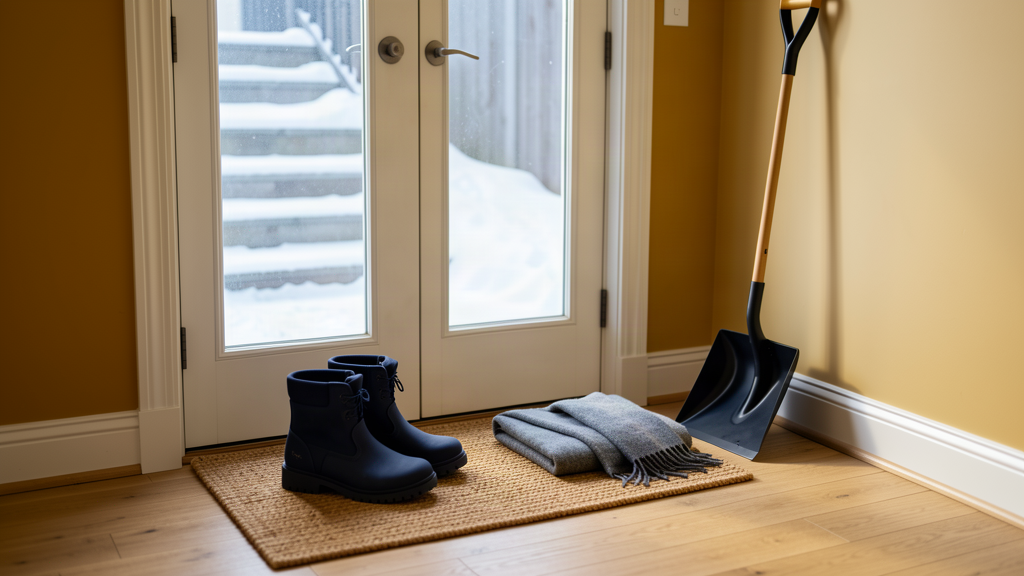
And the last of the housekeeping: use pet-safe ice melt rather than salt if you have pets, keep a pair of boots by the door that you can put on without bending, and put a chair by the door for sitting down to take them off. The little things are the ones you actually do.
Your Next Step
Before the first snow, do two things this week.
- Walk to your own front door as if you were arriving with groceries, and find the spot where you would put your feet if the ground were slick. That is your threshold, and now you know it.
- Make the call about who clears your walk when it snows. Not in December. Now, while it is still a conversation rather than an emergency.
Winter is the season that tests whether the work you did in the fall holds up outdoors. It will, if you go out shorter, slower, and with a plan.
If you have not done the indoor pass yet, start with the room-by-room walkthrough, and take the one-afternoon autumn checklist before the weather turns. The emergency kit is where the storm list lives, and if a fall has already made you cautious, this piece on shrinking your world is the companion to read next - because staying indoors all winter is its own kind of risk.
Sign up for the free guide.