
If you’ve been flinging your arms in the morning for a week or two, you might be wondering: is that it? Am I done?
No. But also: don’t rush.
The arm-fling is the first step. This is the second. Stay on the first for as long as you need - a week, a month, longer. There’s no clock. When the arm-fling starts to feel easy and you want a little more, here’s what I do.
Every single exercise on this list is done standing. You don’t need to get on the floor. You don’t need to kneel. You don’t need equipment. Just you, on your feet, in the open air.
Before You Start
Let me say something important. Pain is bad. Stop if something hurts.
Your body will tell you the difference between “this is uncomfortable because I haven’t done it in years” and “this is hurting because something is wrong.” Listen to it.
I couldn’t do a squat when I started. Not even a partial one. My legs just didn’t have the strength. That’s fine. I worked on it slowly, carefully, over months. Now I can lower myself until I’m sitting on my heels - with a pole for support. That took time. It was worth it.
Uncomfortable is OK. Pain is not.
My Morning Routine
I do everything 10 times. Every morning, before coffee, after the arm-fling. Sometimes I change the order or skip one if my body tells me to. This is my list, not a prescription. Take what works, leave what doesn’t.
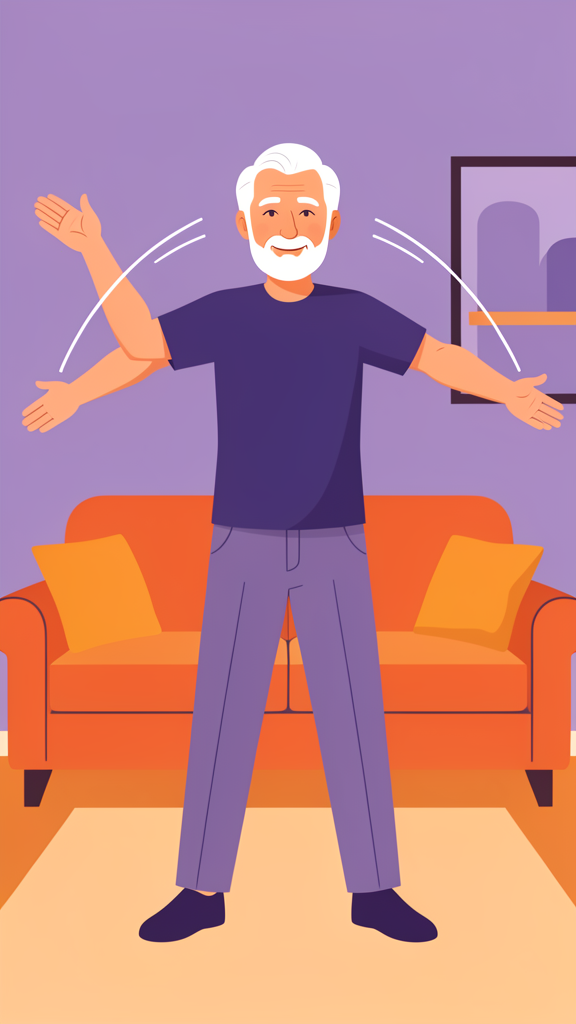
Rotate torso, swinging arms - Stand tall with your feet slightly wider than shoulder-width apart. Extend your arms straight out to your sides, parallel to the floor, keeping them relaxed but straight. Keeping your lower body stable and facing forward, rotate your upper body as far as you comfortably can to the left. Return to center, then rotate to the right. Move slowly and control the twist with your core - don’t just fling your arms. Aim for 15 to 20 rotations per side.
Circulate arms forward, 10 times - Big, slow circles. Like a windmill. Feel the shoulders open up.
Circulate arms backward, 10 times - Same circles, opposite direction.
Swing hips clockwise, 10 times - Hands on hips. Make a slow circle with your hips like you’re tracing a hula hoop. This loosens up the lower back and gets the hip joints moving.
Swing hips counter-clockwise, 10 times - Same thing the other way.
Forward bend - Slowly fold forward from the hips. Let your arms hang toward the ground. Don’t force it. Only go as far as feels comfortable. Hold for a breath, then come back up - one vertebra at a time.
Body-weight squat - Feet slightly wider than hips, toes turned out a little. Push your bum back like you’re about to sit in a chair. Go only as deep as your body allows. I started barely bending my knees. That’s fine. Over time, the depth will come.
Swing right leg - Hold onto something for balance (a wall, a chair, a pole). Swing your right leg forward and backward like a pendulum. Nice and easy. 10 times.
Right leg quad stretch - Still holding onto your support, bend your right knee and grab your foot (or ankle). Pull your heel gently toward your bum. Hold for a few seconds. If you can’t reach your foot, don’t worry - just bend the knee and see how far you get.
Swing left leg - Same as before, other leg.
Left leg quad stretch - Same as before, other leg.
Stand on tip-toes - Slowly rise up onto the balls of your feet. Hold for a moment at the top. Lower back down. This one works your calves and your balance.
That’s it. The whole thing takes maybe 10 minutes.
A Note on the Squat
The squat is the one on this list that most people struggle with. I certainly did. If you can’t do it, don’t do it. There is no shame in skipping an exercise and coming back to it in a month.
But if you want to work toward it, here’s what helped me:
- Use a support - a pole, a door frame, a sturdy chair back
- Go down only as far as you can without pain
- Hold the bottom position for a breath before coming up
- Each week, try to go a tiny bit deeper
Progress here is measured in months, not days. That’s normal. That’s fine.
The Philosophy
You don’t need to add more. You don’t need to make it harder. You don’t need to track anything. If you do this routine every morning for a month, you’ll be ahead of 90% of people your age.
And when it starts to feel too easy - when you’re doing the squats without thinking and the leg swings feel like nothing - then you’ll be ready to talk about the next step.
But that’s another article.
Next: Don’t Fall →